

Latvia is a beautiful, hidden country in Europe next to the Baltic Sea. It sits right between Estonia and Lithuania. Many people do not know where it is on a map, but it has a capital city with huge green forests and a rich culture of singing.
Even though Latvia is small, it has done some amazing things. A Latvian inventor created a famous tiny spy camera, and a Latvian helped invent blue jeans. Latvia also argues playfully with its neighbor about who decorated the very first Christmas tree.
Read More: Explore Our Baltic States Travel Guide

Quick Facts About Latvia
Category | Details |
Official Name | Republic of Latvia |
Capital City | Riga |
Population (2026) | About 1.85 million |
Land Area | 64,589 sq km (24,938 sq mi) |
Official Language | Latvian |
Currency | Euro (€) |
Government | Parliamentary republic |
Continent | Europe (Baltic region) |
Neighboring Countries | Estonia, Lithuania, Russia, Belarus |
Time Zone | UTC+2 (Eastern European Time) |
EU / NATO Member | Yes, since 2004 |
Geography and Nature Facts About Latvia
Latvia features a low-lying, glaciated topography dominated by extensive boreal forest ecosystems and intricate drainage networks. These environmental features make the nation a primary destination for ecological tourism and wilderness research.
1.More Than Half of Latvia is Forest
Woodland ecosystems encompass approximately 54% to 56% of the country’s total land mass, according to classification metrics from the Food and Agriculture Organization (FAO). This high density ranks the territory among the top six most forested nations in Europe. Visitors can traverse dense wilderness tracks for hours without encountering urban development.
2.Latvia Has Close to 12,500 Rivers and Streams
Hydro-geographic baseline mapping indicates that freshwater channels intersect almost every section of the state’s terrain. The landscape also contains over 2,000 deep glacial lakes. This dense fluvial system provides abundant natural irrigation and supports diverse aquatic habitats across rural regions.
3.About 10% of Latvia is Bog or Wetland
These ancient peatland systems have accumulated organic material over thousands of years, operating as critical regional carbon sinks. The terrain functions like a massive natural sponge that regulates local water tables. State-maintained wooden boardwalks allow eco-tourists to safely cross these fragile ecosystems without damaging the sub-surface vegetation.
4.Europe’s Widest Waterfall is in Latvia
The Venta Rapid (Ventas rumba) spans the Venta River within the historic municipality of Kuldīga. The continuous crest line of the fall measures 110 meters across during standard flow periods, expanding up to 249 meters during peak seasonal spring floods. This shallow geomorphological landmark allows visitors to wade across the shelf in summer.
5.Picking Wild Food is Normal Here
Constitutional provisions protect public foraging rights (allemansrätten) across all state-owned wilderness zones. Citizens routinely gather wild boletus mushrooms, cranberries, and bilberries as a core seasonal economic and leisure activity. This deep-rooted cultural tradition peaks every autumn across rural woodlands.
6.Wild Animals Live Close to Towns
Large mammals like Eurasian elk, wild boar, lynx, and grey wolves maintain stable populations inside the nation’s protected reserves. The quiet wetland networks also serve as vital nesting grounds for rare avian species, including the black stork and lesser spotted eagle.
6.History and Culture Facts About Latvia
Latvian history is defined by a multi-century succession of foreign rule, strategic maritime trade placement, and a non-violent twentieth-century mobilization toward national sovereignty. These historical milestones form the bedrock of modern Baltic civic identity.
7.Latvia’s Flag One of the Oldest in the World
Written records within the medieval Livonian Rhymed Chronicle document a crimson-white-crimson battle banner used by tribal militia near Cēsis in 1279. This timeline places the design among the oldest continuously recorded flags globally, chronologically trailing only the national standard of Denmark.
8.Latvia Became Free Two Times
The nation first declared independent statehood on November 18, 1918, following the collapse of the Russian Empire. The territory was subsequently occupied by Soviet and Nazi forces in 1940 during World War II. It remained under Soviet administration until full democratic sovereignty was legally restored on August 21, 1991.
9.Two Million People Once Held Hands In One Long Line
On August 23, 1989, approximately two million citizens formed a contiguous human chain spanning 600 kilometers across Estonia, Latvia, and Lithuania. Known as the Baltic Way, this massive, non-violent demonstration protested the illegal Soviet occupation under the 50th anniversary of the Molotov-Ribbentrop Pact.
10. Singing Helped Latvia Win its Freedom
Between 1987 and 1991, massive public gatherings used traditional polyphonic choral music as a vehicle for political defiance against occupying forces. This non-violent resistance movement is historically cataloged as the Singing Revolution, demonstrating the strategic power of cultural preservation over military force.
11. Latvia Holds One of the Biggest Song Festivals in the World
Held once every five years, the Latvian National Song and Dance Festival assembles over 40,000 choir singers and folk dancers for a week-long convergence in Riga. UNESCO has designated this massive acoustic event as a Masterpiece of the Oral and Intangible Heritage of Humanity due to its scale and preservation of ancient oral traditions.
12. Latians Saved Over One Million Folk Songs
These traditional, short four-line poetic verses are known natively as dainas. Folklorist Krišjānis Barons systematically collected and archived these texts in the late 19th century inside a custom-built cabinet (Dainu skapis), a compilation researchers compare to Homeric epic literature for its cultural value.
13. A Famous Science Project Runs through Latvia
The state hosts several key historical survey markers belonging to the Struve Geodetic Arc, a 2,820-kilometer network of triangulation points crossing 10 European nations. Engineered by astronomer Friedrich Georg Wilhelm von Struve between 1816 and 1855, this UNESCO-listed project determined the exact size and shape of the Earth.
What Is Latvia Famous For? Architecture and Cities
Urban development in Latvia blends medieval trade-network architecture, German Baltic influences, and pioneering early 20th-century European structural design trends.
14. Riga Is Biggest Group of Art Nouveau Buildings in the World
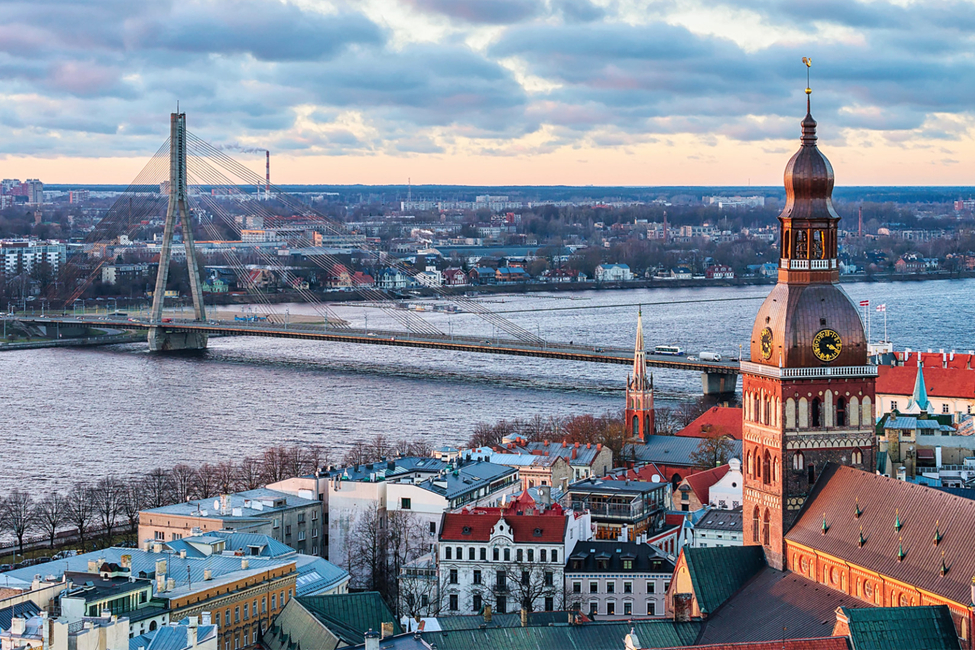
Over one-third of the properties within central Riga exhibit the turn-of-the-century Jugendstil architectural methodology, totaling more than 800 structures. The concentration along Alberta iela showcases highly detailed stone facades, expressive gargoyles, and geometric lines unmatched across Western Europe.
15. Riga’s Old Town is a UNESCO World Heritage Site
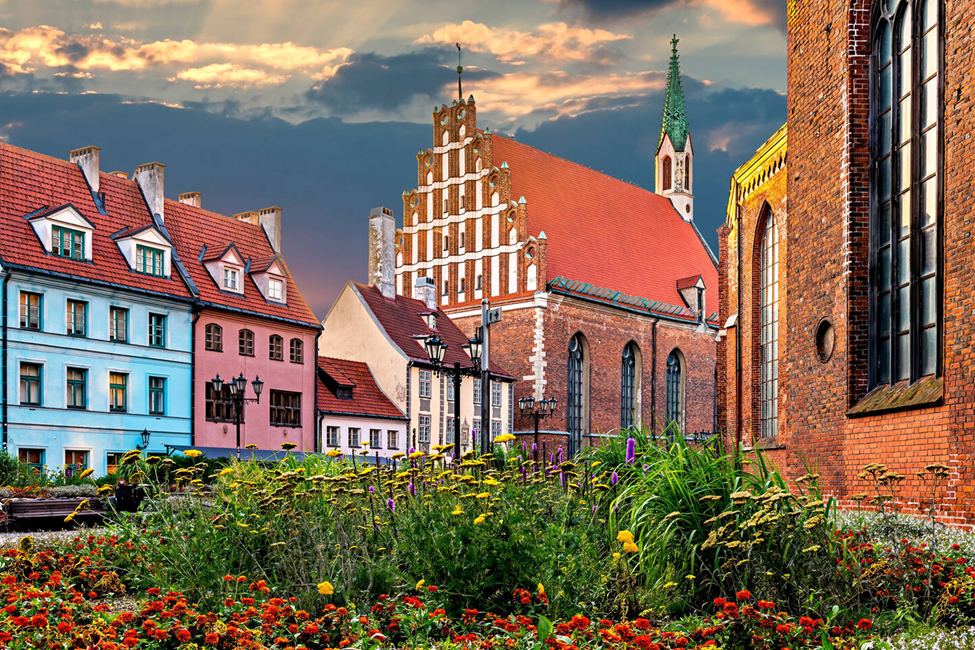
The historical core (Vecrīga) preserves an urban grid layout dating back to its 1201 foundation as a Hanseatic League trading port. Imposing 13th-century brick cathedrals stand directly adjacent to preserved baroque guild houses and mid-century civic properties, creating a distinct visual timeline.
16. Riga Might Have Had the World’s First Decorated Christmas Tree
Historical account ledgers from the Guild of the Black Heads record the public display, decoration, and subsequent ceremonial burning of an evergreen tree in Riga’s town square in 1510. The municipality of Tallinn, Estonia, contests this claim with a 1441 archival record, maintaining an ongoing Baltic tourism rivalry.
17. Latvia Once Planned a Subway that was Never Built
Detailed structural blueprints were finalized in the 1980s for a multi-line underground rapid transit metro system in Riga. The engineering initiative was permanently halted due to high capital costs, widespread civil environmental protests, and challenging hydro-geological conditions involving soft, water-logged soil.
18. You Can Sleep in a Real Old Prison
The Karosta Military Prison in the coastal city of Liepāja functions as an interactive museum and dark tourism hotel. Visitors can sign legal liability waivers to experience authentic Tsarist and Soviet-era disciplinary protocols, including sleeping in authentic concrete cells and undergoing simulated guard interrogations.
Fun Facts About Latvia: Food, Drink, and Daily Life
Daily lifestyle choices, industrial inventions, and culinary traditions across the country reflect an emphasis on self-reliance, seasonal agricultural cycles, and intense athletic focus.
19. A Man from Riga Helped Invent Blue Jeans
Tailor Jacob William Davis was born Jānis Baumanis in Riga in 1831 before emigrating to the United States. In 1873, he partnered with textile merchant Levi Strauss to patent the use of copper rivets to reinforce stress points on heavy-duty canvas work pants, designing the structural blueprint for modern denim apparel.
20. Black Balsam is Latvia’s Most Famous Drink
Rīgas Melnais Balzams is a traditional, highly potent herbal liqueur formulated in 1752 by pharmacist Abraham Kunze. The dark, bitter beverage infuses 24 distinct roots, herbs, and botanicals, utilized natively as a standalone digestif, a coffee additive, or a traditional holistic remedy for seasonal ailments.
21. Latvians Drink a lot of Beer
Market volume analyses indicate an average annual per capita consumption rate of approximately 78 liters of beer. Independent micro-breweries operate across rural provinces, producing traditional unpasteurized varieties that pair with regional smoked meats and dark rye breads.
22. Latvia has One of the World’s Most Northern Open-Air Vineyards
The Sabile Wine Hill (Sabiļas Vīna kalns) has been recognized by the Guinness Book of World Records for its high-latitude viticulture. Positioned at 57°N, the vineyard relies on cold-hardy grape hybrids engineered to withstand short, intense Northern European growing seasons.
23. Rye Bread is a Big Part of Latvian Life
Dark sourdough rye bread (rupjmaize) serves as an essential nutritional staple present at nearly every traditional meal. Cultural taboos strictly forbid wasting or discarding bread, reflecting an ancient agrarian reverence for grain harvests as symbols of household stability.
24. Latvia is One of Only Three Countries Hockey is the Top Sport
Alongside Canada and Finland, ice hockey holds the status of absolute national sport. The country’s bronze medal victory at the 2023 IIHF World Championship triggered an official state holiday, underscoring the deep sociological impact of the sport.
Weird and Unusual Facts About Latvia
From early global colonial ventures to unique bovine genetics, these unusual aspects highlight lesser-known dimensions of the nation’s historical and biological trajectory.
25. Latvia Once Had a Colony Far Away in the Caribbean
During the 17th century, the semi-autonomous Duchy of Courland and Semigallia established a strategic merchant outpost on the island of Tobago between 1654 and 1689. This naval enterprise made the small Baltic principality one of the smallest European entities to ever manage an overseas tropical territory.
26. Latvia has Many More Women Than Men
Demographic census data from the Central Statistical Bureau reveal a distinct gender imbalance, with women outnumbering men by approximately 17% in specific older age cohorts. This gap is primarily attributed to historical wartime losses and shorter male life expectancy trends common to the region.
27. Latvia Gets Almost 20 Hours of Daylight in June
Because of its high northern latitude, summer solstice periods feature extended twilight hours where true darkness is never reached. Citizens celebrate this phenomenon during the national Jāņi holiday on June 23–24, an ancient pagan celebration marked by countrywide bonfires, ethnographical singing, and wild flower crowns.
28. A Rare Blue Cow Breed Lives Only in Latvia
The Latvian Blue cow (Latvijas zilā) is a unique, ancient livestock breed featuring a distinctive blue-grey or light slate-colored coat. Historically tied to Baltic coastal folklore, the hardy breed has been saved from extinction by active conservation breeding initiatives.
29. A Latvian Man Reached the World’s Tallest Waterfall First
Explorer Aleksandrs Laime was the first recorded person to reach the base of Angel Falls (Salto Ángel) in Venezuela by foot in 1946. He subsequently mapped the surrounding subterranean river systems, naming the feeding water supply the Churun River (Rio Gauja) after Latvia’s Gauja River.
30. Latvia Offers Free Public Wi-Fi in Hundreds of Spots
The country maintains an advanced telecommunications framework, with the capital city of Riga hosting over 800 fully free, high-speed public wireless access points. Longitudinal data consistently ranks the country’s fiber-optic infrastructure in the upper tiers of global broadband velocity index tables.
Why These Latvia Facts Matter for Travelers?
Understanding these underlying structural, historical, and ecological facts shifts Latvia from an ambiguous Baltic destination into a highly rewarding travel landscape. The close physical proximity of urban preservation sites and wildlands allows you to seamlessly transition from touring medieval Hanseatic streets in the morning to foraging in dense national parks by afternoon.
The traditional foods, seasonal holiday rituals, and deep-seated environmental laws are not artificial displays designed for commercial tourism; they are preserved components of modern daily life. Exploring this intersection of ancient Baltic culture and advanced digital connectivity explains why the nation remains a standout location for experiential travelers.
Frequently Asked Questions
What is Latvia most known for?
Latvia is known for Riga’s old buildings. It is known for its forests too. It is also known for its Song and Dance Festival. Jacob Davis, who helped invent blue jeans, was born in Riga.
Is Latvia a rich or poor country?
Latvia sits in the middle range. It belongs to the European Union. Its economy uses tech, timber, and tourism. Wages are lower than in Western Europe. The cost of living is lower too.
What language do people speak in Latvia?
Latvian is the official language. It is one of the oldest languages in Europe. Russian is also common. Older people often speak it.
Is Latvia part of the European Union?
Yes, it is. Latvia joined the European Union in 2004. It joined NATO that year too. It uses the euro as money.
What is a fun fact about Latvian food?
Rye bread feels almost sacred here. Wasting it is seen as rude. Black Balsam is a bitter drink found in most Latvian bars.
Is Latvia safe for tourists?
Yes, it is very safe. Crime rates stay low. Riga is easy to walk around. It welcomes English-speaking visitors.
How many days do you need in Latvia?
Most people spend 3 to 5 days in Riga. Add more days for trips outside the city. Sigulda and Cēsis make good day trips.
What makes Latvia different from Estonia and Lithuania?
All three countries share some history. But Latvia stands out for its old buildings. It also stands out for its bogs and its big song festival.
Final Thoughts
Latvia does not brag about itself. That is part of its charm. Quiet forests and simple rye bread hide a rich story. This story has an old flag. It has a festival with 40,000 singers. It has a tailor who helped make blue jeans.
These facts only tell part of the story. Walk through Riga’s Old Town to learn more. Pick berries in a state forest. Try a glass of Black Balsam at night.
Start planning your Baltic adventure with our Latvia travel guides →
Contact us today to begin planning your unforgettable adventure:
- Call us at (800) 778‑9847
- Email: info@vytistours.com
- Visit: com
