

Lithuania & the Baltics
Jessica Parker
·
April 23, 2026
·
13 min read
✦ Key Takeaways
- The Vilnius Christmas Market runs from late November through early January each year, centred in the stunning Cathedral Square.
- Vilnius hosts one of the largest and most beautifully lit Christmas trees in Europe — a centrepiece that draws visitors from across the world.
- Expect over 150 stalls selling handcrafted gifts, amber jewellery, traditional Lithuanian food, mulled wine, and seasonal sweets.
- The market is free to enter and open daily, making it one of the best-value winter experiences in the Baltic States.
- Vilnius Old Town — a UNESCO World Heritage Site — provides one of the most photogenic backdrops of any Christmas market in Europe.
- Combining Vilnius with broader Baltic States tours gives you access to equally magical markets in Riga and Tallinn.
- The best time to visit is the first two weeks of December — festive atmosphere is at its peak and crowds are more manageable.
Table of Contents
- Why the Vilnius Christmas Market Deserves a Spot on Your Bucket List
- Quick Facts at a Glance
- Dates, Hours & Location
- A Brief History of the Vilnius Christmas Market
- The Famous Christmas Tree
- What to Buy: Stalls, Crafts & Souvenirs
- What to Eat and Drink
- Events, Concerts & Activities
- Beyond Cathedral Square: Other Christmas Spots in Vilnius
- Practical Tips for Visiting
- Getting to Vilnius
- Where to Stay Near the Market
- Combine Vilnius With a Baltic Christmas Tour
- FAQs About the Vilnius Christmas Market
Why the Vilnius Christmas Market Deserves a Spot on Your Bucket List
There are Christmas markets, and then there is the Vilnius Christmas Market. Set against the dramatic backdrop of Vilnius Cathedral, centuries-old baroque architecture, and cobblestone streets dusted with winter snow, this annual celebration transforms Lithuania’s capital into one of the most enchanting destinations in all of Europe during the festive season. If you want a deeper sense of the city before you arrive, our guide to things to do in Vilnius and its top must-see attractions is a great starting point.
Every year from late November through early January, Cathedral Square — the beating heart of Vilnius Old Town — fills with the warm glow of thousands of lights, the scent of cinnamon and mulled wine, the sound of carolling choirs, and more than 150 artisan stalls overflowing with handmade treasures. It’s the kind of Christmas market that doesn’t just look good in photographs — it feels good in person.
For travellers considering Lithuania vacation packages, December is genuinely one of the finest months to visit. The country’s capital reveals a completely different, deeply romantic personality in winter — and the Christmas market is the centrepiece of it all. Whether you’re a solo traveller, a couple in search of a magical winter escape, or a family looking to create unforgettable memories, Vilnius at Christmas delivers in every sense.
In this complete travel guide, we cover everything you need to know — from dates, stalls, and food to getting there, where to stay, and how to fold the market into a wider Baltic adventure.
Quick Facts at a Glance
| Location | Cathedral Square (Katedros aikštė), Vilnius Old Town, Lithuania |
| Dates | Late November – early January (typically Nov 28 – Jan 6) |
| Hours | Sunday–Thursday: 10:00 – 21:00 | Friday–Saturday: 10:00 – 22:00 |
| Entry | Free admission |
| Weather | Typically 0°C to -5°C (32°F to 23°F) — dress in warm layers |
| UNESCO Status | Vilnius Old Town is a UNESCO World Heritage Site (since 1994) |
| Getting There | 30 min from Vilnius Airport; well-connected by rail from Warsaw, Riga, Tallinn |
| Best Time to Visit | First two weeks of December for atmosphere without peak crowds |
Dates, Hours & Location
The Vilnius Christmas Market officially opens on the last Saturday or Sunday of November and runs through January 6th (Epiphany / Three Kings Day), which marks the traditional end of the Christmas season in Lithuanian culture. The market spans several areas of the Old Town, but its main hub is Cathedral Square — Katedros aikštė — with additional stalls and light installations spreading through the surrounding streets and Gediminas Avenue.
Markets are open daily throughout the festive season. On weekdays (Sunday through Thursday), stalls are typically open from 10:00 to 21:00. On Fridays and Saturdays, they stay open until 22:00 to accommodate evening visitors who come specifically for the atmosphere after dark — which, to be honest, is when Vilnius is at its absolute most magical. For a full picture of what to expect from the city in the cold months, read our dedicated guide to Vilnius in winter.
A Brief History of the Vilnius Christmas Market
Christmas markets in the Baltic region have roots stretching back to medieval trade traditions, and Vilnius is no exception. While the modern incarnation of the Vilnius Christmas Market in its current form has been running for over two decades, the city’s festive markets have historical precedent going back centuries to when Cathedral Square served as the central marketplace of the city.
The modern market as it’s known today grew significantly in scope and ambition after Lithuania joined the European Union in 2004 and began attracting growing numbers of international tourists. According to the Lithuania Travel official tourism board, Vilnius now receives hundreds of thousands of visitors during the winter season, with the Christmas market as the primary draw.
What sets Vilnius apart from the more commercialised Christmas markets of Western Europe is its genuine cultural rootedness. Many of the traditions observed at the market — the straw decorations, the amber jewellery, the songs, the food — are expressions of living Lithuanian culture and traditions rather than tourist recreations. The market takes real pride in featuring authentic local artisans over mass-produced goods.
The connection between Christmas and Lithuanian cultural identity runs especially deep. If you want to understand why the festive season feels so meaningful here, our guide to Lithuanian Christmas traditions and Kūčios explores the spiritual and cultural significance of Christmas Eve in Lithuania — a fascinating read before your visit.
The Famous Christmas Tree
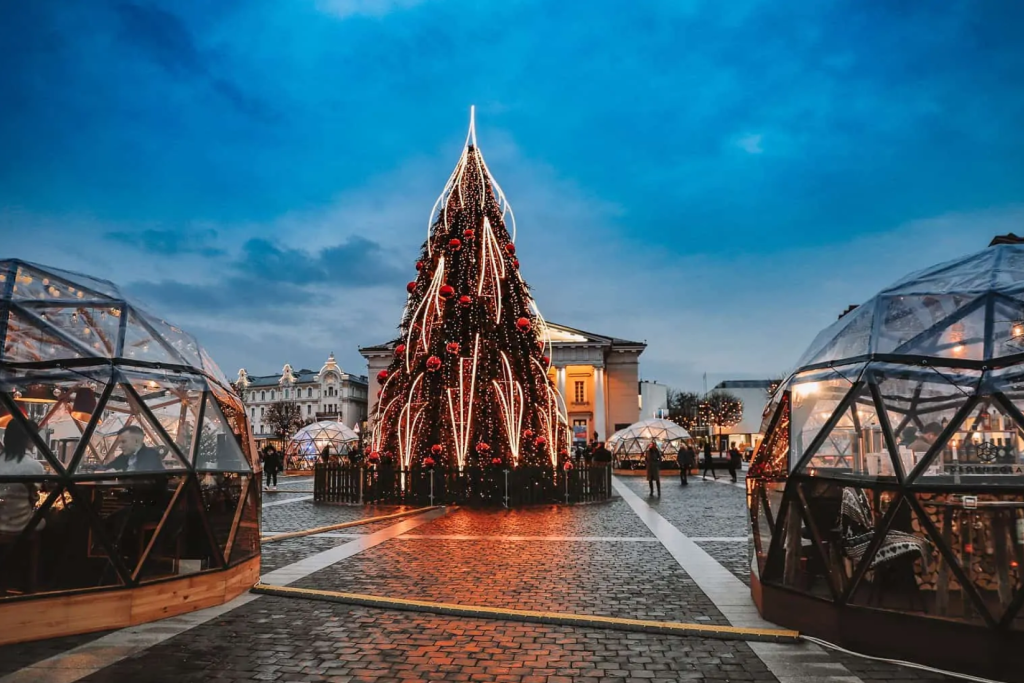
Ask any visitor what they remember most about the Vilnius Christmas Market and the answer is almost always the same: the tree. Each year, a monumental Christmas tree is erected in Cathedral Square, and it has become one of the most talked-about festive trees in Europe. The tree is not merely large — it is breathtaking.
Decorated with tens of thousands of lights, handcrafted ornaments, and traditional Lithuanian folk motifs, the tree typically stands between 20 and 30 metres tall, making it visible from across the Old Town. The lighting ceremony that marks the official opening of the market draws enormous crowds and is broadcast live across Lithuanian media — it’s the moment the festive season truly begins for the whole country.
In recent years, Vilnius has won multiple awards and widespread international attention for its Christmas tree design. Time Out and other major travel outlets have consistently ranked Vilnius among the top Christmas market destinations in Europe, with the tree frequently cited as a highlight.
What to Buy: Stalls, Crafts & Souvenirs
The Vilnius Christmas Market is not a place for mass-produced trinkets. The market organisers apply strict quality standards, and the majority of vendors are genuine Lithuanian craftspeople selling handmade goods. This commitment to authenticity makes it one of the best Christmas markets in Europe for actually finding meaningful, high-quality gifts and souvenirs.
Amber — Lithuania’s Gold
Lithuania sits on the shores of the Baltic Sea, which means it has one of the richest amber deposits in the world. The Christmas market is an exceptional place to buy Baltic amber jewellery — earrings, necklaces, bracelets, and decorative pieces — directly from craftspeople who know their material intimately. Look for the warm honey-gold pieces typical of Lithuanian amber, and ask vendors about inclusions (prehistoric insects or plant matter trapped inside) which make each piece unique. Amber is also one of the most memorable things to bring home from a wider Baltic States tour.
Straw Decorations — Šiaudų Sodas
One of the most distinctive Lithuanian folk craft traditions is šiaudų sodas — intricately woven straw mobile sculptures that hang from ceilings and sway gently in the breeze. Originally created as good-luck symbols for the home, these geometric straw constructions are one of the most authentic souvenirs you can buy at the market. They are fragile and lightweight, making them perfect for packing in carry-on luggage.
Linen and Wool Textiles
Lithuania has a rich tradition of linen weaving, and the market features vendors selling handwoven linen tablecloths, towels, scarves, and blankets. These are practical, beautiful, and genuinely made in Lithuania — a world away from the tourist-shop imports you’ll find elsewhere.
Wooden Crafts and Folk Art
Hand-carved wooden ornaments, nativity scenes, decorative crosses, and folk figurines fill many stalls. The carved wooden crosses of Lithuania — part of the country’s UNESCO-recognised cultural heritage — are particularly special. If you visit the Hill of Crosses near Šiauliai as part of your Lithuania trip, you’ll appreciate the deep symbolism behind these carvings even more.
Ceramics and Candles
Glazed ceramic ornaments, pottery, and beeswax candles in traditional shapes are popular at the market. Lithuanian beeswax candles have a distinctive warm honey scent and burn beautifully — they make thoughtful and practical gifts that travel well.
Experience the Vilnius Christmas Market With Vytis Tours
We’ve been crafting Baltic journeys for over 33 years. Our Lithuania vacation packages include festive winter tours designed around the Christmas Market season — guided by local experts who know Lithuania inside and out.
What to Eat and Drink at the Vilnius Christmas Market
One of the great joys of any Christmas market is the food — and Vilnius delivers some of the most distinctive and delicious festive eating in the Baltic region. The market stalls serve both traditional Lithuanian dishes and universal winter favourites, all prepared with fresh local ingredients. If you’d like a fuller picture of the national cuisine before your trip, our guide to traditional Lithuanian food covers all the must-try dishes in depth.
Must-Try Foods
- Šakotis (Tree Cake): Lithuania’s most iconic traditional cake, cooked on a rotating spit over an open flame to create a distinctive spiky shape resembling a pine tree. Crispy on the outside, soft and eggy within — it’s the taste of a Lithuanian Christmas. You’ll often see it being made live at the market.
- Cepelinai (Zeppelin Dumplings): Lithuania’s national dish — large potato dumplings stuffed with minced meat or curd, served with sour cream and bacon. Hearty, warming, and absolutely perfect on a cold December evening.
- Kibinai: Pastry pockets filled with meat or vegetables, originally from the Karaite community of Trakai. They’re sold hot and make an ideal snack while wandering the market.
- Smoked sausages (dešrelės): Grilled over open coals and served with mustard and dark rye bread, these are quintessential market food — simple, smoky, and satisfying.
- Honey cake and gingerbread: Intricately decorated gingerbread (meduoliai) is both a food and an art form at Lithuanian Christmas markets. Many stalls sell beautifully iced pieces that double as edible decorations.
- Varškės spurgos (Curd cheese doughnuts): Soft, lightly fried doughnuts made with curd cheese and dusted with sugar — a delicious, uniquely Lithuanian sweet treat.
What to Drink
- Karštas vynas (Mulled wine): Rich, spiced, and served steaming hot in ceramic mugs that you can take home as a souvenir. Lithuanian mulled wine often incorporates local berry notes for a distinctly Baltic flavour.
- Midus (Mead): Lithuania has a centuries-old tradition of mead-making, and the Christmas market is an excellent place to try warm mead — honey wine spiced with herbs and citrus. It’s warming, sweet, and utterly unique to the region.
- Gira (Kvass): A traditional fermented rye bread drink that is mildly alcoholic and surprisingly refreshing even in winter. It tastes like bread and honey and feels deeply traditional.
- Hot chocolate and cider: For non-drinkers and families, thick hot chocolate and warm spiced apple cider are widely available and equally delicious.
Events, Concerts & Activities at the Market
The Vilnius Christmas Market is far more than a shopping experience — it’s a full cultural programme that runs throughout the festive season. The main stage in Cathedral Square hosts a packed schedule of free performances, making every visit feel like a special occasion.
Live Music and Carol Concerts
Throughout December, choirs, folk ensembles, brass bands, and solo artists perform on the Cathedral Square stage almost every evening. Performances range from traditional Lithuanian Christmas carols (kalėdinės giesmės) to contemporary festive music and classical concerts. Many performances are by professional ensembles — the quality is genuinely impressive and entirely free to watch.
Craft Workshops
Several stalls offer live craft demonstrations and hands-on workshops where you can try making straw decorations, painting ceramic ornaments, or learning basic amber jewellery techniques. These are especially popular with children and families, and sessions are typically short and drop-in.
The Christmas Tree Lighting Ceremony
Held on the final Saturday or Sunday of November, the official tree-lighting ceremony is a major public event. Thousands gather in Cathedral Square to watch the countdown, enjoy performances, and witness the moment the tree illuminates the entire square in gold and white. If you can time your trip to coincide with this event, do it — the atmosphere is extraordinary.
Santa’s Visits and Children’s Activities
Throughout the market season, regular visits from Santa Claus (known in Lithuanian as Kalėdų Senelis) are scheduled, particularly on weekends. Children’s workshops, storytelling sessions, and interactive games are organised throughout the festive period, making the market genuinely family-friendly.
New Year’s Eve Celebrations
Cathedral Square transforms into a spectacular New Year’s Eve venue, with fireworks over the square and live entertainment throughout the evening. Many visitors specifically plan their Vilnius trip around New Year’s Eve to experience the combination of Christmas market atmosphere and the city’s legendary celebrations.
Visit Vilnius, Riga & Tallinn Christmas Markets on One Tour
All three Baltic capitals run spectacular Christmas markets in December. Our Baltic States tours connect Vilnius, Riga, and Tallinn in one seamlessly guided winter journey — the ultimate festive Baltic adventure.
Beyond Cathedral Square: Other Christmas Spots in Vilnius
While Cathedral Square is the centrepiece, the Christmas spirit spills out across the entire city. Here are other spots worth visiting during your festive trip to Vilnius:
Town Hall Square (Rotušės aikštė)
A short walk from Cathedral Square, Town Hall Square hosts its own Christmas market with a slightly different character — more focused on food and local produce. The ornate Town Hall building makes a stunning backdrop, and the crowds are noticeably thinner than at the Cathedral Square market.
Pilies Street and the Old Town
The entire stretch of Pilies Street — the main artery of the Old Town — is transformed for Christmas, with lights strung across the street and small pop-up stalls selling gifts and hot drinks. Walking from Cathedral Square down Pilies Street toward the Gates of Dawn feels like wandering through a living Christmas card.
Gediminas Avenue
Vilnius’s main boulevard is lit with thousands of LED lights and decorations from November through January. The light installations change each year and draw professional photographers from across Europe. An evening stroll along Gediminas Avenue is a must, especially after dark.
Užupis Bohemian Quarter
The quirky, artistic self-declared “Republic of Užupis” hosts its own intimate festive market with a decidedly artsy character — independent artists, unusual crafts, and a warm community atmosphere that feels distinctly different from the main market. A short walk across the Vilnelė River, it’s well worth the detour.
Day Trip: Trakai Castle
Just 30 kilometres from Vilnius, the medieval island castle of Trakai is stunning in any season — but in winter, surrounded by frozen lakes and snow-covered forests, it takes on a truly fairy-tale quality. Many visitors to the Vilnius Christmas Market combine their trip with a day visit to Trakai, which is easily done by suburban train in about 30 minutes. Our guide to the best things to do in Trakai covers exactly how to plan the perfect day trip.
Day Trip: Druskininkai Winter Spa Escape
Lithuania’s beloved spa resort town of Druskininkai, about 130 kilometres south of Vilnius, takes on a particularly cosy character in winter. The town’s thermal spas, mineral water pools, and forest trails offer a perfect contrast to the city bustle. See our full guide to the best things to do in Druskininkai if you’d like to add a day trip or overnight stay.
Practical Tips for Visiting the Vilnius Christmas Market
What to Wear
December in Vilnius is genuinely cold — temperatures regularly drop to -5°C or colder, and wind chill along the open square can make it feel significantly colder. Dress in proper winter layers: thermal base layers, a warm mid-layer, a windproof and waterproof outer coat, warm socks, insulated boots, gloves, and a hat. Do not underestimate the cold — even visitors from cold climates are often caught out by the wind off the Baltic plain.
Best Days to Visit
Weekday evenings (Tuesday to Thursday) offer the best combination of festive atmosphere and manageable crowd levels. Weekends — particularly in the second and third weeks of December — are significantly busier with both local families and tourists. If you want the full buzz of the market at maximum atmosphere, visit on a Saturday evening in early December. If you prefer breathing room, a Wednesday afternoon into evening is ideal.
Getting Around
The Old Town is pedestrianised, so once you’re in Cathedral Square you explore everything on foot. Vilnius has excellent public transport: trolleybuses and buses connect all major districts, and the central train and bus stations are a 15-minute walk from the Old Town. Rideshare apps (Bolt is dominant in Vilnius) are reliable and inexpensive.
Language and Payment
English is widely spoken in Vilnius, particularly in the Old Town, restaurants, and hotels. Lithuanian is the official language — learning a few phrases (ačiū for “thank you”, labas for “hello”) will always earn a smile. Lithuania uses the Euro (€). Most restaurants and large craft stalls accept Visa and Mastercard; smaller food vendors often prefer cash.
Photography
Vilnius at Christmas is one of the most photogenic places in Europe. Cathedral Square — with the tree, the cathedral, and the illuminated cobblestones — offers truly world-class shots. For the best photos of the tree, visit just after sunset when the sky still holds some deep blue colour. A wide-angle lens or a modern smartphone in Night Mode will produce stunning results. The reflections on the wet cobblestones after light rain or snow are particularly spectacular.
Getting to Vilnius
Vilnius is increasingly well-connected internationally, making it easier than ever to visit for a Christmas market trip.
By Air
Vilnius International Airport (VNO) is served by direct flights from most major European hubs, including London, Amsterdam, Frankfurt, Paris, Warsaw, and many more. Ryanair, Wizz Air, and airBaltic all operate routes to Vilnius, often at very reasonable prices if booked in advance. The airport is about 7 kilometres south of the city centre — a taxi or Bolt ride takes around 20 minutes and costs approximately €10–15.
By Train and Coach
Vilnius is connected by train to Warsaw (approximately 8–9 hours), and within the Baltics, coach services via Lux Express connect Vilnius with Riga (approximately 4 hours) and Tallinn (approximately 9 hours). FlixBus also serves the major Baltic routes at competitive fares.
If you’re travelling from the coast, note that Klaipėda on Lithuania’s Baltic coast is well-connected to Vilnius by train and bus — combining a coastal visit with the capital’s Christmas market makes for an excellent winter itinerary.
Where to Stay Near the Vilnius Christmas Market
For maximum convenience and atmosphere, staying in or immediately adjacent to the Vilnius Old Town puts you within walking distance of everything. The Old Town contains a wide range of accommodation options, from boutique hotels in converted baroque palaces to well-priced guesthouses and apartments.
Old Town (Best for Atmosphere)
Staying in the Old Town means you’re steps from Cathedral Square, so you can stroll to the market at any time of day or evening without needing transport. Prices are higher here — especially in December — so book well in advance. Look for boutique hotels on Pilies Street, Stiklių Street, and the streets radiating from Town Hall Square for the most characterful options.
Naujamiestis (New Town — Best for Value)
The New Town district, centred on Gediminas Avenue, is a 10–15 minute walk from Cathedral Square and offers more affordable accommodation options without sacrificing comfort. Most of the city’s mid-range hotels and well-rated apartments are located here.
Booking Tips
December is high season in Vilnius — accommodation fills up fast, particularly for weekends and the Christmas/New Year period. Book at least 2–3 months in advance for the best selection and prices. The week between Christmas and New Year is the busiest and most expensive period.
Combine Vilnius With a Wider Baltic Christmas Tour
Lithuania is the southernmost of the three Baltic States, and all three capitals — Vilnius, Riga, and Tallinn — run exceptional Christmas markets in December. Combining all three in a single trip is an increasingly popular itinerary that lets you experience three distinct cultures, three stunning Old Towns, and three world-class Christmas markets across one unforgettable winter journey.
This kind of multi-city Baltic Tours is exactly what Vytis Tours specialises in. With over 33 years of experience crafting Baltic itineraries, our team knows how to pace a winter trip through all three capitals so you get the best of each without rushing. We handle logistics, accommodation, local guides, and all the details — you simply show up and enjoy.
A typical Baltic Christmas tour runs 7–10 days and might look something like this:
- Days 1–3 — Vilnius: Arrive in Vilnius, explore the Old Town, visit the Christmas Market in Cathedral Square, and take a day trip to Trakai Castle.
- Days 4–5 — Riga: Travel north to Riga for Latvia’s famous Christmas Market in the Dome Square — one of the oldest in Eastern Europe.
- Days 6–8 — Tallinn: Continue to Estonia’s medieval capital for the Tallinn Christmas Market, widely regarded as one of the most beautiful in all of Europe.
- Days 9–10 — Return: Flexible return from Tallinn by air, or loop back through Riga and Vilnius.
Beyond the capitals, Lithuania’s regional towns each have their own festive charms. The spa town of Druskininkai draws winter visitors with its thermal spas, while the historic city of Anykščiai is known for its forest canopy walk — spectacular even in snow. The coastal resort of Palanga takes on a quieter, romantic winter mood that many travellers find more appealing than its summer crowds. And for those who enjoy exploring off the beaten track, the towns of Kernavė and Biržai both offer fascinating history and uncrowded winter charm.
Book Your Baltic Christmas Market Tour Today
Vytis Tours designs personalised Lithuania vacation packages and Baltic tours that make the most of every destination. Let our experts handle the details while you focus on the magic.
FAQs About the Vilnius Christmas Market
When does the Vilnius Christmas Market start and end?
The market typically opens on the last weekend of November (around November 28–29) and runs through January 6th (Epiphany). The exact opening dates vary slightly each year, so check the Vilnius Tourism official website for confirmed dates closer to your travel date.
Is the Vilnius Christmas Market free to enter?
Yes — entry to the market is completely free. You only pay for what you eat, drink, or buy from the stalls. This makes it one of the most accessible and best-value Christmas market experiences in Europe.
Is the Vilnius Christmas Market good for families with children?
Absolutely. The market is very family-friendly, with regular Santa visits, craft workshops for children, storytelling sessions, and a range of food that appeals to all ages. The open square is pushchair-friendly, and the festive atmosphere genuinely enchants younger visitors.
What is the best time of day to visit?
Late afternoon through evening is by far the best time to visit. The lights come on around 15:30–16:00 in December, transforming the square into something truly magical. If you arrive at 16:00 and stay until 20:00, you’ll experience the market at its most atmospheric.
How many days do I need in Vilnius for Christmas?
Two full days is the minimum to cover the main Christmas market, the Old Town highlights, and a day trip to Trakai. Three to four days gives you time to explore Vilnius more deeply, visit the best restaurants in Vilnius, and soak up the festive atmosphere at a relaxed pace. If you’re combining Vilnius with a wider Baltic States tours, allocate 2–3 days per city.
What currency is used in Lithuania?
Lithuania uses the Euro (€) — it joined the Eurozone in 2015. Currency exchange is straightforward, and ATMs are widely available throughout the Old Town. Credit and debit cards are accepted in most restaurants, hotels, and larger stalls at the market.
Is Vilnius safe for tourists?
Vilnius is a very safe city for tourists. According to Numbeo’s safety index, Vilnius ranks among the safer European capitals. Standard precautions apply — be mindful of your belongings in crowded market areas, particularly on busy weekend evenings.
Final Thoughts
The Vilnius Christmas Market is the kind of travel experience that stays with you long after the hot mulled wine has cooled and the straw ornaments have found their place on your Christmas tree at home. It’s a market that feels genuinely Lithuanian — rooted in culture, crafted with care, and set against one of the most beautiful urban backdrops in all of Europe.
Whether you visit Vilnius as a standalone winter city break or as part of a wider tours to Lithuania, you will not be disappointed. The combination of UNESCO-listed architecture, living Lithuanian folk tradition, exceptional food, and genuine festive warmth makes December in Vilnius something truly special. Start planning now — and if you’d like expert help building the perfect Baltic winter itinerary, the team at Vytis Tours has been doing exactly this for over three decades.
More Lithuania Travel Guides
Vilnius in Winter: Everything You Need to Know
Things to Do in Vilnius
Best Restaurants in Vilnius
Traditional Lithuanian Food Guide
Lithuanian Culture and Traditions
Best Things to Do in Trakai
Best Things to Do in Druskininkai
Things to Do in Klaipėda
Best Things to Do in Palanga
Best Things to Do in Šiauliai
Best Things to Do in Kernavė
Best Things to Do in Anykščiai
Best Things to Do in Biržai
Best Things to Do in Panevėžys
Best Things to Do in Alytus
Best Things to Do in Marijampolė
Best Things to Do in Jonava
Best Things to Do in Telšiai
Palace of the Grand Dukes of Lithuania
Jessica Parker
Travel Writer & Baltic Culture Specialist
Jessica has spent over a decade travelling through the Baltic States and writing about their cities, cultures, and hidden corners. She has attended the Vilnius Christmas Market four times — in rain, sleet, and snow — and considers the tree-lighting ceremony one of the most joyful public events in Europe. She writes for Vytis Tours to help travellers make the most of every Baltic journey.
Contact Vytis Tours Now!
At Vytis Tours, we’ve been the trusted journey partner for Baltic States Tours across Estonia, Latvia, and Lithuania for over 32 years—curating immersive experiences that blend iconic sights with authentic cultural encounters. Whether you’re longing to explore medieval castles, experience Lithuanian traditions, or enjoy the pristine landscapes of the Baltic coast, our expertly designed Baltic vacation packages offer flexibility, local insight, and seamless service.
Contact us today to begin planning your unforgettable adventure:
Call us at (800) 778‑9847
Email: info@vytistours.com
Visit: VytisTours.com
